SANDISK Doubles Capacity and Improves Performance of Its SSD Product Lines

New Solid State Drives Ideal for Notebooks, Netbooks, Tablet Computers and Other Thin and Lightweight Computing Devices
- 100% Capacity Increase Lets OEMs Provide Customers With More Storage
- Speed Boost Improves Boot Times and System Responsiveness
- Available in Variety of Form Factors to Meet Manufacturers’ Stringent Requirements
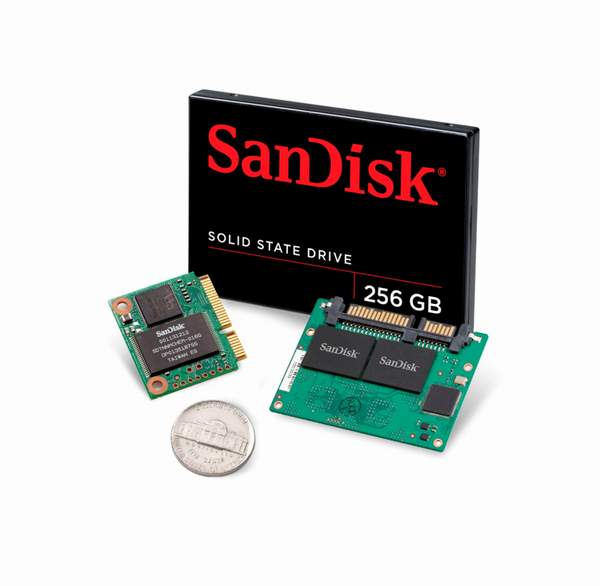
Computex 2010, Booth #N0108, Taipei, June 1, 2010 – SanDisk Corporation (NASDAQ: SNDK), the global leader in flash memory cards, today introduced its latest solid state drive (SSD) products. The SanDisk® SSD G4 serves as a drop-in replacement for hard disk drives (HDD) in notebooks; while the SanDisk® SSD P4, the successor to the widely used pSSD modular drive, enables designers to offer even thinner netbook and tablet computers.
The new drives offer a unique balance of performance, high-capacity storage and long-term reliability. SanDisk SSD P4 and SanDisk SSD G4 offer up to 128 gigabytes (GB)1 and 256GB of storage respectively, double the capacities of the company’s previous SSD offerings. The drives are available in various compact form factors, which SanDisk can customize according to manufacturers’ specification, offering greater freedom and flexibility in how OEMs design their products. The SSDs use SanDisk’s advanced 32-nanometer (nm) multi-level cell (MLC) process technology, which enables cost-competitive high-capacity storage with a tiny footprint.
“We designed our new SSDs with long-term consumer usage in mind,” said Doron Myersdorf, senior director, SSD marketing, SanDisk. “Our drives offer faster boot times and improved system responsiveness while maintaining our uncompromising reliability standards. In addition, the drives utilize our Adaptive Flash Management (AFM) technology, which enables them to bridge the gap between demanding market requirements and increasingly challenging raw NAND flash characteristics.”
SanDisk SSD G4 Balances Fast Performance, Storage and Long-term Endurance
- Capacity and Performance. Ranging from 64GB to 256GB with sequential read/write speeds of up to 220 and 160MB/sec3. The drive’s combination of high capacities and performance delivers the fast boot times, enhanced system responsiveness and space needed to easily handle storage-intensive data such as videos, photos, music and games.
- Endurance. SanDisk SSD G4 offers Long-term Data Endurance (LDE) of 160 terabytes written (TBW) for a 256GB drive, sufficient for over 10 years of PC usage4, well beyond a typical user’s length of ownership of a computer.
- Page-based Algorithm. To accelerate performance and extend the drive’s endurance, the SSD G4 uses ExtremeFFS, a page-based algorithm that significantly increases random write speeds and efficiency2. This AFM implementation for SSD G4 enables the drive’s unique balance between fast performance and long-term endurance.
- Flexible Form Factors. SanDisk offers customized form factors to meet stringent OEM requirements, enabling thin and lightweight laptop designs that cannot be achieved using a standard HDD.
“Enhanced user experience and long-term reliability are two qualities of SSDs that directly impact the end-user and ultimately represent what consumers care about,” said Jeff Janukowicz, research manager, solid state drives, IDC. “Solid state drives like the SanDisk SSD G4 that optimize around actual usage scenarios and device endurance, as opposed to sufficing solely on device level metrics, should provide a better indication of real world performance.”
SanDisk SSD P4 Enables the Emerging Tablet and Handheld Computing Market
- Large Capacity, Tiny Footprint. With capacities ranging from 8GB to 128GB, the drive lets OEMs equip small devices with big storage where a bulky HDD is not an option. The drive is available in various form factors that include a new ultra-small variant of the mSATA module, mSATA mini, with dimensions of 26.80 x 30.00 x 3.4 mm. This is SanDisk’s tiniest SATA module form factor.
- Performance. SanDisk AFM implementation for SanDisk SSD P4 uses nCache™ acceleration technology, a large non-volatile write cache technology that boosts burst random write performance to shorten boot times, help prevent “stalling” and “hiccups,” and increase system responsiveness. The SanDisk SSD P4 offers burst random 4KB performance of up to 600 IOPS.
- Multiple Applications. SanDisk SSD P4 is ideal for use in small devices such as netbooks, smartbooks, tablet computers and ultra-thin notebooks, in addition to POS terminals, Set Top Boxes (STBs), printers and other devices that use embedded flash.
Pricing and Availability
The SanDisk SSD G4 and SanDisk SSD P4 are currently being evaluated by top tier OEMs. High-volume production of the drives is expected in the Q3 2010 timeframe with product available to OEMs at that time; pricing will depend on the quantity ordered.
SSD Advantage
Unlike conventional HDDs, SSDs have no moving parts, improving durability which helps prevent data loss resulting from drive failure. In addition, SSD-equipped computers run cooler and more quietly, consume less power and deliver faster performance than those using HDDs.
Fast Boot Demonstration at Computex Booth #N0108
Insyde Software is working with SanDisk and Microsoft Corp. to address the growing demand from consumers and PC makers to reduce boot times and operating system load times. At the SanDisk booth #N0108, Computex attendees can witness a demonstration of a notebook PC using SanDisk G3 SSD power-on to Windows Desktop in less than 15 seconds.
More Articles